
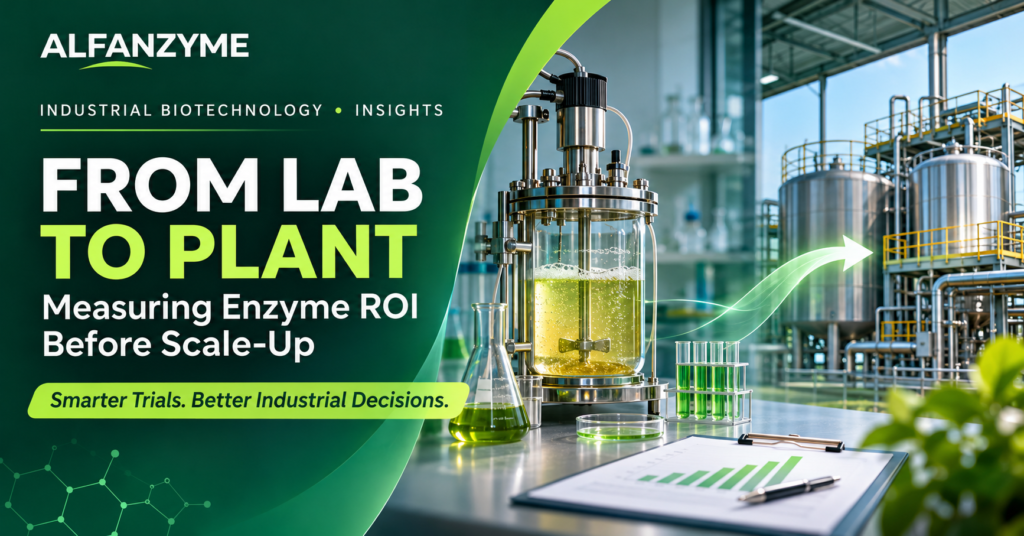
From Lab to Plant: How to Measure Industrial Enzyme ROI Before Scale-Up
Smarter Enzyme Trials. Better Industrial Decisions.
Introduction: When Laboratory Success Meets Industrial RealityIn modern manufacturing, efficiency is no longer measured only by how much a plant produces. It is also measured by how intelligently resources, energy, raw materials, and technology are utilized.Industrial enzymes are helping companies explore new possibilities in process optimization, product quality, and sustainable production. However, one important question often remains unanswered:
How can an industry determine whether an enzyme solution will deliver measurable value at commercial scale?
The answer lies in structured enzyme trials, performance monitoring, and Return on Investment (ROI) analysis. At Alfanzyme, we believe industrial biotechnology should be evaluated not only for scientific effectiveness but also for its practical contribution to operational performance.
Why Successful Laboratory Results Are Not Enough
An enzyme may demonstrate excellent activity under controlled laboratory conditions. But industrial plants operate under changing temperatures, pH levels, processing times, feedstock quality, and production demands.
For example, an enzyme tested successfully on a small sample may behave differently when introduced into a continuously operating production system.
This is why scaling up requires more than increasing the enzyme dosage.
Successful implementation depends on understanding:
Operating temperature and pH
Raw material characteristics
Enzyme concentration and contact time
Compatibility with existing equipment
Process stability and consistency
Total operating cost
Evaluating these factors helps industries make informed decisions before commercial implementation.
Establish a Clear Performance Baseline
Before introducing any enzyme solution, manufacturers must understand their existing process performance.
A baseline provides the reference against which improvements can be evaluated.
For a sugar mill, relevant indicators may include sugar recovery, juice viscosity, processing time, and product quality.
For a distillery, the focus may be on fermentation efficiency, residual starch, ethanol yield, and process consistency.
In food processing, manufacturers may measure extraction yield, clarity, processing efficiency, and finished-product characteristics.
The key principle is simple:
Improvement cannot be accurately measured without reliable baseline data.
Design an Enzyme Trial Around Real Industrial Conditions
The most effective trials are designed to answer specific operational questions.
Instead of simply asking whether an enzyme works, manufacturers should ask:
Does this enzyme improve a measurable outcome under our actual operating conditions?
A structured evaluation should compare an untreated or standard-process control against the enzyme-treated process, while keeping relevant operating variables as consistent as practical.
Testing different enzyme dosages may help identify the point where additional treatment no longer generates meaningful economic benefits.
Where possible, trials should be repeated across representative batches or operating conditions to determine whether results are reproducible.
Calculate the Real Return on Investment
An enzyme that improves technical performance does not automatically improve profitability.
The financial benefit must be measured against the full incremental cost of implementation.
Enzyme ROI (%) = [(Incremental Financial Benefits − Incremental Costs) ÷ Incremental Costs] × 100
Financial benefits may come from higher production yield, improved product quality, lower energy consumption, reduced processing time, or lower material losses.
Incremental costs may include enzyme procurement, dosing equipment, testing, process adjustments, operator training, and additional maintenance.
For example, consider a hypothetical trial where an enzyme application generates ₹2,50,000 in incremental financial benefits and costs ₹1,00,000 to implement.
The calculated ROI would be 150%.
This example is illustrative, not a claim about actual Alfanzyme product performance. Actual results depend on process conditions, production scale, and verified trial data.
Look Beyond Immediate Cost Savings
Some industrial improvements are difficult to capture through a single financial indicator.
More consistent processing, fewer quality deviations, reduced material waste, and improved operational flexibility can create additional value.
For this reason, an enzyme evaluation should consider technical, economic, and environmental performance together.
Environmental benefits should also be verified through relevant measurements rather than assumed from the use of biotechnology alone.
A complete evaluation provides decision-makers with a stronger foundation for long-term process improvement.
Move from Pilot Trials to Commercial Implementation
Once laboratory and pilot-scale results are promising, the next step is controlled industrial validation.
Manufacturers should confirm that the enzyme performs consistently under real production conditions, including normal variations in raw material quality and plant operation.
A phased implementation strategy allows technical teams to refine dosing, monitor critical parameters, evaluate risks, and establish performance benchmarks.
The decision to scale up should be based on three essential questions:
Is the process technically effective?
Is the performance consistent and reproducible?
Is the expected economic value greater than the total implementation cost?
When all three questions are supported by reliable data, manufacturers are better positioned to make a commercially sound decision.
Alfanzyme: Connecting Biotechnology with Industrial Performance
At Alfanzyme, our approach to industrial enzyme solutions emphasizes application-specific performance, innovation, and process optimization.
Industries have different operating environments, raw materials, and production challenges. An enzyme solution that performs well in one application may require modification or further evaluation in another.
By focusing on technical understanding and appropriate application, biotechnology can become a valuable part of industrial improvement strategies.
Our objective is to help industries explore practical enzyme solutions that support performance, efficiency, and responsible manufacturing.
Conclusion: Make Every Enzyme Investment Count
The future of industrial biotechnology is not just about developing more effective enzymes. It is about demonstrating their value in real manufacturing environments.
From laboratory trials to industrial implementation, each stage should create measurable evidence that supports smarter decision-making.
The right enzyme, the right process, and the right performance data can make all the difference.
Explore Industrial Enzyme Solutions with Alfanzyme
Looking to evaluate enzyme-based opportunities for your manufacturing process?Connect with Alfanzyme to discuss your application, operating challenges, and technical requirements.
Website: https://alfanzyme.com/
Alfanzyme — Advancing Industrial Efficiency Through Biotechnology.
