
Industrial Enzyme
The sugar industry is one of the world's most important agro-based industries, but sugar manufacturing involves several complex processing stages, from sugarcane preparation and juice extraction to clarification, evaporation, crystallization, and final sugar recovery. Maintaining efficiency, improving sugar yield, reducing processing losses, and managing waste are major priorities for modern sugar manufacturers.
Industrial enzymes in the sugar industry are increasingly used as process-aid solutions to improve specific processing steps. These enzymes can help sugar mills optimize processing conditions, control unwanted components, improve filtration, and support better overall process efficiency.
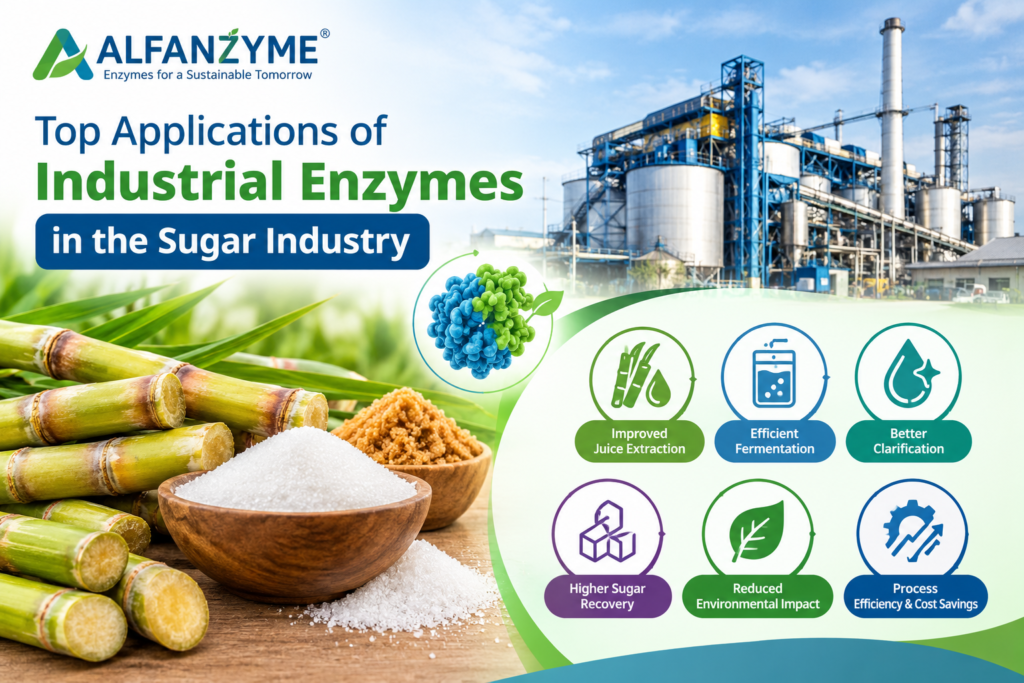
In this article, we explore the top applications of industrial enzymes in sugar manufacturing and how enzyme technology can contribute to more efficient and sustainable sugar production.
What Are Industrial Enzymes?
Industrial enzymes are biological catalysts used to accelerate specific chemical or biochemical reactions during industrial processes. They are commonly produced using microorganisms through controlled fermentation and are designed to work under particular processing conditions.
In the sugar industry, enzymes can be selected according to the raw material, process conditions, impurities, and desired production outcomes.
Depending on the application, different enzyme systems may be used to address challenges associated with starch, dextran, viscosity, filtration, juice clarification, and other process-related issues.
Why Are Enzymes Used in the Sugar Industry?
Sugar mills continuously look for ways to improve productivity while maintaining consistent sugar quality. Enzyme-based process solutions can provide targeted support at different stages of sugar manufacturing.
Key reasons for using enzymes include
Improving process efficiency
Controlling unwanted polysaccharides and impurities
Reducing viscosity-related processing problems
Supporting better juice clarification
Improving filtration performance
Reducing sugar losses during processing
Supporting better crystallization and sugar recovery
Optimizing overall plant performance
Helping reduce processing challenges associated with variable cane quality
The exact benefits depend on the enzyme, dosage, process conditions, and operating parameters of the sugar mill.
Top Applications of Industrial Enzymes in the Sugar Industry
1. Dextran Control in Sugar Processing
One of the important applications of industrial enzymes in sugar mills is the management of dextran.
Dextran is a high-molecular-weight polysaccharide that can develop when sugarcane is exposed to certain microorganisms, particularly when cane is delayed before processing. High dextran levels can negatively affect sugar processing by increasing viscosity and interfering with crystallization and filtration.
Dextranase enzymes are designed to hydrolyze dextran into smaller molecules, helping reduce its impact on the process.
Potential benefits include
2. Starch Reduction in Sugar Juice
Sugarcane can contain starch, particularly depending on cane variety, maturity, and growing conditions. Excessive starch can create processing challenges and may affect filtration and crystallization.
Amylase enzymes can be used to hydrolyze starch into smaller components
The application of amylase in sugar processing may help:
