
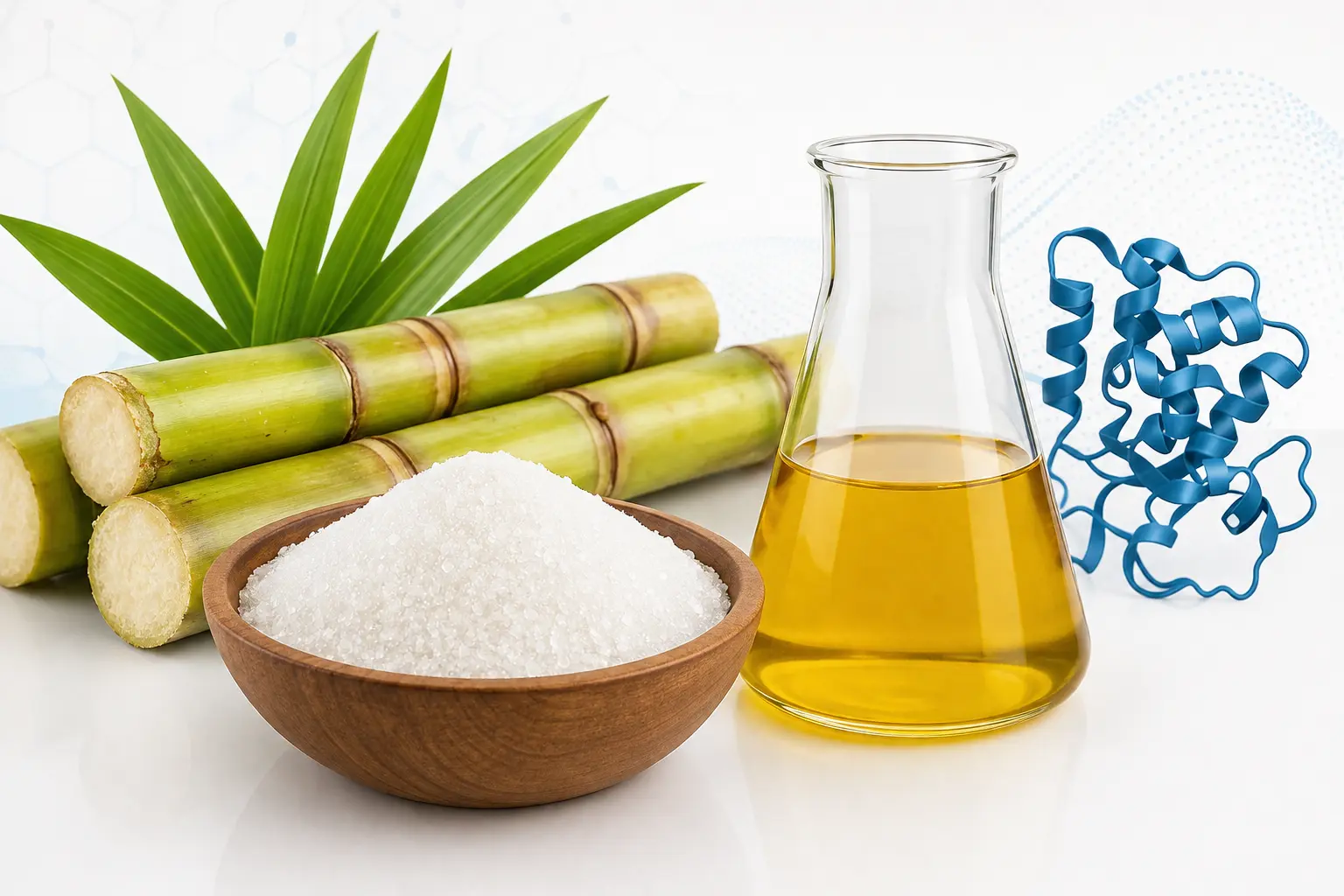
Sugar recovery can be increased by using enzymes to break down dextran, reduce juice viscosity and improve clarification — addressing the losses that occur between cane crushing and final crystallisation. Dextranase, amylase and specialised process enzymes target sucrose that would otherwise be lost to degradation, molasses or filter cake, helping mills raise recovery percentage without capital-heavy plant changes.
Why Recovery Percentage Is the Number That Matters
For a sugar mill, recovery percentage is the clearest measure of operating performance. It expresses how much of the sucrose entering with the cane actually leaves as sugar. Cane quality, crushing efficiency, process losses and molasses exhaustion all feed into it — and a fractional improvement, applied across an entire crushing season, translates into a substantial commercial gain.
Much of the sucrose that goes missing is not lost in one dramatic place. It leaks away gradually: degraded by microbial activity in delayed cane, trapped in filter cake, held back by poor clarification, or left unexhausted in final molasses. Enzymes address several of these leak points directly.
Where Sugar Is Actually Lost
- Cut-to-crush delay – harvested cane left standing invites microbial activity that converts sucrose into dextran and other by-products
- Poor juice clarification – incomplete settling carries impurities forward and lowers final quality
- High viscosity – thick juice and syrup slow evaporation, hinder crystallisation and impede filtration
- Filter cake losses – sucrose retained in mud leaves the process entirely
- Unexhausted molasses – recoverable sugar remaining in the final molasses stream
The Dextran Problem
Dextran is the single most damaging contaminant in a delayed-cane scenario. Produced by bacteria acting on damaged or stale cane, it is a long-chain polysaccharide that creates disproportionate trouble for its concentration.
Dextran sharply raises viscosity, which slows filtration and evaporation. It distorts sucrose crystals into elongated needle shapes that are difficult to purge and cure. It inflates polarimeter readings, so laboratory results overstate the sugar actually present. And it drives more sucrose into final molasses.
Dextranase is the enzyme that directly hydrolyses dextran into smaller fragments, neutralising these effects. In mills facing harvest delays, transport bottlenecks or burnt cane, dextranase is often the highest-return enzyme intervention available.
Enzymes Used in Sugar Processing
Enzyme | Target | Recovery Benefit |
Dextranase | Dextran from stale cane | Lowers viscosity, restores crystal shape |
Amylase | Starch in cane juice | Improves filtration and clarity |
Process blends | Gums and impurities | Better clarification and settling |
Viscosity reducers | Thick juice / syrup | Faster evaporation and boiling |
Amylase for Starch Control
Cane naturally contains starch, and levels rise with immature or stressed cane. Starch impedes filtration, raises viscosity and carries through to the refinery, where it degrades sugar quality. Amylase breaks starch down into smaller units that pass through the process without causing these problems.
Clarification and Viscosity Support
Beyond the two headline enzymes, blended formulations target the gums and polysaccharides that hinder settling. Better clarification means cleaner juice moving forward, reduced scaling in evaporators and improved throughput across the boiling house.
A Practical Approach to Raising Recovery
- Measure before you dose. Establish baseline dextran, starch, viscosity and recovery figures so any change is provable, not anecdotal.
- Address cane supply timing. Enzymes manage the consequences of delay, but reducing cut-to-crush time attacks the cause. Do both.
- Dose at the correct point. Enzyme addition point determines contact time and effectiveness — typically early enough for the enzyme to act before the target impurity does its damage.
- Control pH and temperature. Enzyme activity falls sharply outside its optimal window; process conditions must support the enzyme, not fight it.
- Adjust through the season. Cane quality varies from season start to close. A fixed dosage all season is rarely optimal.
- Track outcome metrics. Monitor filtration rates, crystal quality, evaporation performance and final molasses purity — not just recovery in isolation.
What Realistic Results Look Like
Enzymes are not a substitute for good milling practice, cane management or well-maintained equipment. What they do is recover sugar that current practice is losing — particularly under the conditions Indian mills routinely face: harvest delays, variable cane quality, burnt cane and seasonal peaks that stretch capacity.
The commercial logic is favourable because the intervention is operational rather than capital. There is no plant redesign involved; the change is a dosing programme integrated into existing process points, which means results appear within the same season rather than after a payback period.
Frequently Asked Questions
How can sugar recovery be increased in a sugar mill?
Sugar recovery can be increased by reducing process losses: controlling dextran with dextranase, breaking down starch with amylase, improving juice clarification, lowering viscosity for better evaporation, and reducing sucrose left in filter cake and final molasses.
What is dextran and why does it reduce sugar recovery?
Dextran is a polysaccharide produced by bacteria acting on stale or damaged cane. It raises viscosity, distorts sugar crystals into needle shapes, gives false polarimeter readings and pushes more sucrose into final molasses, all of which reduce recovery.
What does dextranase do in sugar processing?
Dextranase hydrolyses dextran into smaller fragments, reducing juice viscosity, restoring normal crystal formation, improving filtration and evaporation rates, and lowering sugar losses to molasses.
Why is starch a problem in cane juice?
Starch impedes filtration, increases viscosity and carries through to the refinery where it affects sugar quality. Amylase breaks it down so it passes through the process without causing these issues.
Do enzymes require changes to mill equipment?
No. Enzyme programmes are dosed into existing process points and do not require plant redesign, which is why results can be seen within the same crushing season.
Losing sugar to dextran or poor clarification? Alfanzyme’s technical team can assess your process conditions and recommend an enzyme programme matched to your cane quality and mill setup.
Contact: alfanzyme.com/sugar-alcohol | info@alfanzyme.com | +91 9353031105
