
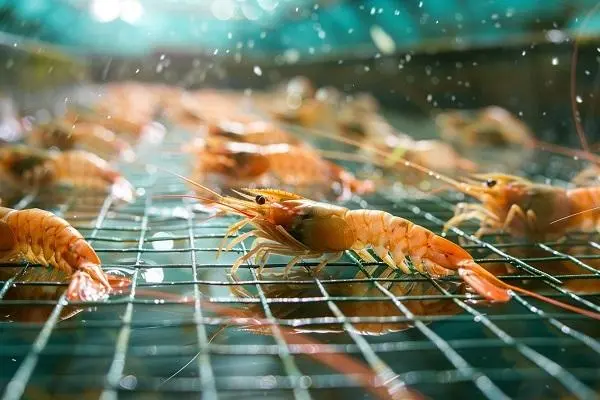
Aquaculture enzymes and probiotics improve pond health by breaking down organic waste, controlling ammonia and nitrite, and suppressing harmful bacteria. Enzymes degrade uneaten feed, faecal matter and sludge at the pond bottom, while beneficial bacterial cultures consume the resulting nutrients and compete with pathogens. The result is cleaner water, more stable pond chemistry and better growth and survival rates in shrimp and fish.
Why Pond Water Quality Determines the Crop
In intensive shrimp and fish culture, the pond is a closed system carrying a heavy organic load. A significant share of the feed given is never eaten, and what is eaten returns as waste. Over a cycle this accumulates as sludge at the pond bottom — the black, foul-smelling layer that farmers know signals trouble.
That accumulated organic matter drives the two problems that most often end a crop early: rising ammonia and nitrite, and proliferation of pathogenic bacteria, particularly Vibrio species. Both are consequences of organic load rather than independent events, which is why managing the load is the most effective intervention available.
How Enzymes and Probiotics Work Together
The two work in sequence, and using one without the other limits results.
Enzymes act first. Protease, amylase, lipase and cellulase break down the proteins, starches, fats and fibre in uneaten feed, faeces and dead algae. These molecules are too large for bacteria to absorb directly, so without enzymatic breakdown they simply settle and accumulate.
Probiotic bacteria act second. Selected beneficial strains consume the smaller compounds the enzymes release, converting them into biomass rather than allowing them to decay into ammonia. They also compete with pathogenic bacteria for nutrients and space, suppressing Vibrio populations without antibiotics.
What This Delivers in the Pond
Problem | Mechanism | Result |
Bottom sludge | Enzymatic breakdown of organics | Cleaner pond bottom, less dredging |
Ammonia / nitrite spikes | Nitrifying bacterial cultures | More stable water chemistry |
Vibrio pathogens | Competitive exclusion | Lower disease pressure |
Poor water clarity | Reduced organic load | Better light and oxygen conditions |
Low FCR | Improved feed digestion | Better growth per kg of feed |
Ammonia and Nitrite Control
Ammonia is toxic to shrimp at low concentrations and stresses the animal well before it kills. Nitrifying bacteria convert ammonia to nitrite and then to relatively harmless nitrate. Where these bacterial populations are weak — early in a cycle, or after a water exchange or chemical treatment — ammonia accumulates. Adding selected cultures restores that pathway.
Disease Pressure and Antibiotic Reduction
Competitive exclusion is the principle that a pond dominated by beneficial bacteria has less room for pathogens. This matters commercially as well as biologically: export markets scrutinise antibiotic residues closely, and a probiotic-led approach to disease management protects market access as well as the crop.
Feed Enzymes for Shrimp and Fish
Enzymes are also applied through feed rather than water. Protease, amylase and phytase improve digestion and nutrient release in the animal, which improves growth and simultaneously reduces the undigested fraction reaching the pond. Better feed digestion reduces the waste load at source.
Practical Application Guidance
- Start early – beneficial populations take time to establish; dosing from pond preparation is more effective than reacting to a crisis
- Dose consistently – periodic application through the cycle maintains the population as organic load rises
- Separate from disinfectants – chlorine and strong oxidisers kill probiotic cultures; treatments must be spaced apart
- Maintain aeration – most beneficial bacteria are aerobic and will not perform in oxygen-depleted water
- Monitor, don’t guess – track ammonia, nitrite, pH and dissolved oxygen so dosing responds to actual conditions
- Combine with good practice – enzymes reduce the consequences of overfeeding but do not substitute for feed management
Relevance to Indian Aquaculture
India’s shrimp sector, concentrated in Andhra Pradesh, Tamil Nadu, Odisha and Gujarat, operates at high stocking densities where organic load management is decisive. Combined with export market sensitivity to antibiotic residues, this makes biological pond management a commercial requirement rather than an optional practice.
Frequently Asked Questions
What do aquaculture enzymes do in a pond?
Aquaculture enzymes break down uneaten feed, faecal matter, dead algae and bottom sludge into smaller compounds that beneficial bacteria can consume, reducing organic load and improving water quality.
How do probiotics reduce disease in shrimp ponds?
Beneficial bacterial strains compete with pathogens such as Vibrio for nutrients and space. This competitive exclusion suppresses pathogen populations and lowers disease pressure without relying on antibiotics.
How can ammonia be reduced in a shrimp pond?
Ammonia is reduced by lowering the organic load that generates it and by supporting nitrifying bacteria that convert ammonia to nitrite and then nitrate. Enzyme and probiotic programmes address both.
When should pond probiotics be applied?
Application should begin at pond preparation and continue periodically through the cycle. Beneficial populations take time to establish, so starting early is more effective than dosing in response to a water quality problem.
Do disinfectants affect pond probiotics?
Yes. Chlorine and other strong disinfectants kill beneficial bacteria. Probiotic application must be spaced apart from any disinfection treatment.
Managing sludge, ammonia or disease pressure in your ponds? Alfanzyme’s aquaculture team can recommend an enzyme and probiotic programme matched to your stocking density and pond conditions.
Contact: alfanzyme.com/aquaculture | info@alfanzyme.com | +91 9353031105
